
ENGINEERED CLARITY. COST CERTAINTY.
Front-End Engineering Design (FEED) A tender-ready definition package that strengthens estimates, reduces execution risk, and accelerates delivery.
Front-End Engineering Design (FEED) is the engineering phase completed before Detailed Engineering, Procurement, and Construction. It converts a project concept into a defined, costable, and tender-ready scope—so owners and contractors can validate technical feasibility, confirm execution strategy, and lock a reliable budget and schedule basis prior to bid submission. When FEED is done properly, it becomes the project’s risk-reduction engine: it clarifies scope, strengthens constructability, improves cost and schedule confidence, and reduces late design changes that often drive variations, rework, and claims during execution.
FEED that prevents Rework
FEED That Prevents Rework
APD applies proven plant-construction lessons to deliver a clear, coordinated, costable FEED. The result is fewer Engineering, Procurement, and Construction changes, less rework and variation, and stronger schedule control.
Data-Driven FEED Delivery
Data-Driven FEED Delivery
APD uses robust databases and engineering tools to deliver a reliable FEED with speed and consistency. Standardized templates and workflows improve accuracy, shorten cycle time, and produce a clear, traceable package.
Stakeholder Alignment That Holds
Stakeholder Alignment That Holds
APD delivers stronger FEED outcomes through clear communication and mutual respect across stakeholders. Disciplined engagement aligns requirements early, manages interfaces, and documents decisions—reducing late changes and keeping delivery execution-ready.
Basic Engineering
At APD, Front-End Engineering Design (FEED) is the Basic Engineering phase completed after Conceptual Design / Early Planning or a Feasibility Study. It is also commonly called Front-End Loading or Front-End Engineering.
Before Engineering, Procurement, and Construction, FEED validates key technical assumptions, defines scope and interfaces, and establishes a credible cost and schedule basis. It is typically performed by an engineering contractor or an Engineering, Procurement, and Construction contractor, either as a standalone scope or through tender.
The output is the FEED Package—a structured set of documents that forms the basis for Engineering, Procurement, and Construction bidding and execution planning.

Inputs required for FEED Project
To proceed efficiently with a Front-End Engineering Design (FEED) engagement, APD typically requires the following baseline inputs:
FEED Scope of Work (units, battery limits, interfaces, deliverable list, and responsibilities)
Feasibility Study / Concept Package (Basis of Design, technology selection, capacity, product specs, key assumptions)
Site and Location Data (plot boundary, surveys, geotechnical and environmental data available, utilities, access, constraints)
Applicable Codes and Standards (local regulations, industry standards, project specifications)
Client Technical Practices and Requirements (engineering standards, preferred vendors, documentation format, HSE and quality requirements)
With these inputs aligned upfront, FEED becomes a disciplined planning tool that improves scope clarity, cost certainty, and tender readiness—reducing late changes during Engineering, Procurement, and Construction.
ENGINEERED CLARITY. COST CERTAINTY.
Types of FEED Engagements Front-End Engineering Design (FEED) Deliverables by Level of Definition
FEED scope can vary depending on the level of definition required before tendering for Engineering, Procurement, and Construction. At APD, FEED engagements are typically delivered in three levels: Basic FEED, Intermediate FEED, and Extended FEED. Each level increases the depth of engineering, interface resolution, and deliverable completeness—improving cost certainty and execution readiness. Below is a practical view of FEED deliverables, using piping engineering as a reference discipline.

BASIC FEED
Definition Level 1
Purpose: Define the project footprint and piping basis to align early costs and tenders.
Best for: Early definition, budget screening, EPC tender preparation.
Key deliverables (piping reference):
- Overall plot plan (high-level)
- Piping Material Specification
- Tie-in and battery limit basis

INTERMEDIATE
Definition Level 2
Purpose: Strengthen interface clarity and design basis to improve estimate accuracy and constructability.
Best for: Competitive tendering, clearer interfaces, reduced EPC rework.
Key deliverables (in addition to Basic):
Piping purchase specification
Piping layout design basis
Piping stress design basis
Interface register
Demolition/modification scope basis (if applicable)
Plot plan concept notes and key assumptions

EXTENDED FEED
Definition Level 3
Purpose: Deliver an execution-ready FEED package with deeper layout, piping integrity, and model definition.
Best for: Complex brownfield/tie-ins, tight schedules, high cost certainty.
Key deliverables (in addition to Basic + Intermediate):
Unit plot plan and equipment layout
Pipe rack sections and routing basis
Pipe thickness calculations
Valve datasheets
Preliminary stress analysis (routing/loads)
Piping support standard
Preliminary 3D model
Typical FEED Deliverables for Process Engineering
During Front-End Engineering Design (FEED), the process engineering team produces the core technical definition that drives equipment selection, line sizing, safety requirements, and cost accuracy for tendering. Typical process FEED deliverables include:
Process Flow Diagrams and Preliminary Piping and Instrumentation Diagrams
Establish process configuration, operating philosophy, major equipment, and initial control and isolation intent.Process Simulation and Modelling
Develop heat and material balances, operating cases, turndown scenarios, and utility consumption to validate performance and sizing.Design Basis and Technical Specifications
Issue the process design basis, assumptions, product specifications, feedstock ranges, and operating envelopes that govern all downstream engineering.Equipment Sizing and Datasheets
Size major process equipment and prepare datasheets for vendor budgetary quotations and procurement planning.Safety Device Sizing and Selection
Define relief philosophy, size pressure relief valves and vent/flare systems where applicable, and establish safeguarding requirements aligned with early safety studies.Hydraulic Calculations
Perform key hydraulic assessments for process and utility systems (pressure drop, pump/compressor heads, line velocities) to confirm operability and layout feasibility.Piping and Line Sizing Basis
Set preliminary pipe sizing criteria and line list inputs to support routing, tie-ins, and early material quantity estimates.
Outcome: A process-defined FEED package that strengthens scope clarity, cost certainty, operability, and tender readiness—reducing late-stage changes during Engineering, Procurement, and Construction.

Client-Specific Requirements
A strong Front-End Engineering Design (FEED) package reflects the client’s project-specific requirements from day one—so scope is clear, interfaces are controlled, and major changes during execution are minimized. Throughout FEED, APD works closely with project owners, operators, and stakeholders to capture operational intent, maintainability expectations, safety standards, and site constraints—turning them into documented, traceable design requirements.
FEED focuses on defining the technical requirements and identifying the project’s main cost drivers. It establishes the basis for Engineering, Procurement, and Construction pricing, supports risk identification, and creates the execution-ready definition needed before Detailed Engineering. Compared with a traditional estimate, FEED is more rigorous because requirements are extracted and validated early, reducing uncertainty and strengthening cost and schedule confidence.
Typical client-specific items developed during FEED include:
- Project organization and responsibility matrix
- Defined scope, battery limits, and interface register
- Discipline design basis (civil, mechanical, process, electrical, instrumentation)
- Safety and operability studies (Hazard and Operability study, safeguarding philosophy, ergonomic considerations)
- Preliminary two-dimensional and three-dimensional models
- Equipment layout and installation philosophy
- Engineering design package and specifications
- Major equipment list and preliminary datasheets
- Automation and control strategy
- Process Flow Diagrams and preliminary Piping and Instrumentation Diagrams
- Schedule basis and project timeline
- Tender-ready pricing basis (supporting a fixed-price or lump-sum approach where required)
Outcome: A client-aligned FEED package that improves tender quality, reduces variation risk, and strengthens execution readiness.
APD FEED Methodology
At APD, Front-End Engineering Design (FEED) is a disciplined approach to define a project before Detailed Engineering—aligning technical choices, constructability, safety, and cost/schedule certainty. While FEED is not a one-size-fits-all exercise, APD applies a consistent methodology that keeps scope traceable, decisions documented, and execution risk reduced.
Key considerations during FEED include:
Degree of automation
Define the appropriate level of automation for the application and operations strategy, impacting equipment selection, layout, staffing, and costs.Performance rates and design capacities
Confirm throughput, turndown, availability targets, and operating cases—drivers that influence sizing, utilities, and schedule.Material specifications and compatibility
Select construction materials based on process conditions, corrosion/erosion risk, and durability—reducing integrity issues and lifecycle costs.Codes, standards, and regulatory requirements
Align design with applicable standards and local regulations early to avoid redesign, permitting delays, and compliance gaps.Assumptions, exclusions, and potential constraints
Document assumptions and exclusions, identify key constraints and risks, and translate them into a managed action plan before execution.
Outcome: A FEED package that is clear, cost-effective, and tender-ready—built to minimize late changes and strengthen Engineering, Procurement, and Construction delivery.

Expansion plans
FEED should not only define the initial project scope—it should also protect the project’s future growth pathway. Where expansion is anticipated, FEED typically outlines the staging concept and the physical provisions needed to enable future phases, even if the exact expansion timeline is not yet confirmed.
To safeguard expandability, FEED commonly:
Reserves dedicated plot space for future units and tie-ins
Provides expandable layout planning (access, pipe racks, corridors, foundations where applicable)
Identifies future battery limits and interfaces to avoid rework
Allows for capacity allowances in utilities and offsites where practical
In practice, the area allocated for future expansion is treated as a protected zone and is not encroached by permanent facilities—so future phases can be executed efficiently with minimal disruption to ongoing operations.
Time Duration for FEED Project
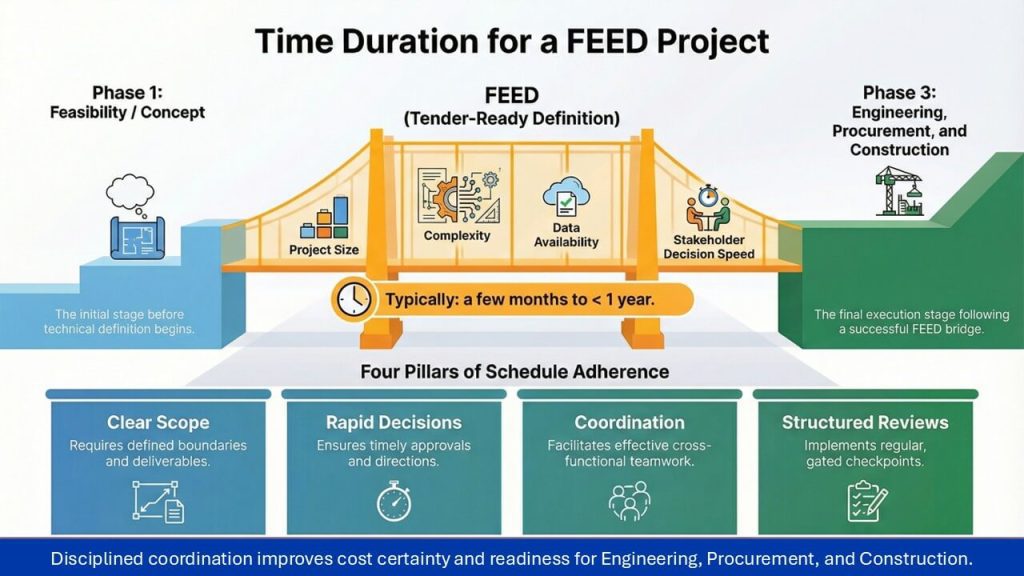
Front-End Engineering Design (FEED) is typically delivered on a fast-track schedule, because it sits between feasibility and execution and must reach a tender-ready level quickly. Most FEED engagements are completed in a few months to under one year, depending on project size, complexity, data availability, and stakeholder decision speed.
To meet schedule without compromising quality, FEED requires:
Clear scope and timely inputs from the client
Rapid decision-making on key technical and commercial assumptions
Close coordination between the owner/operator and the engineering team
Structured reviews and approvals to lock requirements and avoid late changes
With strong collaboration and disciplined governance, FEED can be completed efficiently while delivering the cost certainty and execution readiness needed for Engineering, Procurement, and Construction tendering.
ENGINEERED CLARITY. COST CERTAINTY.
FEED vs Detailed Engineering From Cost Certainty to Construction Readiness
Front-End Engineering Design (FEED) and Detailed Engineering are two distinct stages in the project life cycle. FEED develops the basic engineering needed to define scope, reduce risk, and establish a credible cost and schedule basis for investment and contracting. Detailed Engineering then completes the design to Issued For Construction level—enabling procurement, fabrication, installation, and commissioning with minimal rework.

Front-End Engineering Design (FEED)
Definition engineering for scope, cost, schedule, and bankability.
- Locks the Basis of Design and project boundaries (battery limits and interfaces).
- Defines the concept to support credible project costing and schedule logic.
- Establishes contracting and packaging strategy (EPC tender package / EPCM scopes).
- Produces key definition deliverables: Process Flow Diagrams, preliminary Piping and Instrumentation Diagrams, equipment list, plot plan, preliminary electrical load list.
- Runs early safety and operability work (Hazard Identification and early Hazard and Operability study planning).
Outcome: Definition-ready (investable/tenderable), not construction-ready.

Detailed Engineering
Execution engineering delivering constructible design and Issued For Construction packages.
- Produces Issued For Construction drawings and specifications aligned to construction methods.
- Finalizes calculations, material take-offs, and full coordination across disciplines.
- Integrates vendor data and resolves interfaces for procurement and fabrication release.
- Delivers MEI packages: piping isometrics/spools/supports; single line diagrams/cable schedules; loop diagrams/hook-ups/cause-and-effect/logic diagrams.
- Completes safety study close-out (Hazard and Operability study close-out; Safety Integrity Level where applicable).
Outcome: Build-ready (procure / fabricate / install / test / commission).
Have Questions? We’ve Got Answers.
FREQUENTLY ASKED QUESTIONS (FAQs)
Front-End Engineering Design (FEED) is the phase completed before Detailed Engineering, procurement, and construction to define scope, reduce uncertainty, and deliver a tender-ready engineering package.
What is a FEED study?
The Front-end engineering and design process is one of the most important pre-project planning activities. A typical FEED study consists of producing technical documents, confirming product specifications, clarifying the project scope, and estimating the approximate project cost.
What is pre-FEED engineering?
Pre-FEED Engineering is a preliminary step that is usually undertaken before starting the basic engineering work. Pre-FEED engineering is an optional project phase and may be skipped. In the pre-FEED stage, the technical and economical feasibility of the project is sometimes confirmed. Depending on the nature of the project and uncertainties involved, a Pre-FEED work may be combined with conceptual work and studies.
What is the front-end of a project?
The front-end phase of a project is the initial phase of a project when the project idea is conceived. The front-end phase of the project ends when the final decision to start or not-no start the project is decided.
What comes after FEED Engineering?
Front-End Engineering Design identifies all technical requirements, potential risks, and approximate costs of the proposed project. Once there is a green signal for the project execution, Detailed Design Engineering or Detailed Engineering, or DD engineering comes in place. So, Detailed Engineering comes after FEED engineering.
Connect with Us today
Simple solutions for complex problems Discover how we deliver value to our clients.
Give us a call or send us a message to learn more about our Company, culture, solutions, or services. Choose what suits you the best.
We work better when we all work together!
Join Our Team Your talent will shape our history
Our road to success lies in recruiting, attracting, and retaining the best people, and in developing them into professionals who excel in their respective fields.
We offer careers in various specialties. If you believe you have what it takes to help us become successful, we would like to hear from you.
Join our team today, and together we will grow!